
What Is Litha and How to Celebrate It Today
Source: Pinterest
The days have been getting longer for months and suddenly you feel it: a warm fullness in the air. The light stays until it seems almost unreasonable. The mornings are warm before you've finished your first cup of coffee. Everything outside is green and buzzing and alive in a way that makes you want to be outside for no reason except that it feels good to be there.
That feeling has a name too. And once you know it, you'll understand why so many women are making it part of how they mark the year.
It's Litha. And it's the longest day of the year.
What Is Litha?
Litha is the summer solstice celebration observed in modern pagan and Wiccan traditions, falling between June 20th and 22nd in the Northern Hemisphere. It marks the longest day and shortest night of the year, the moment when the sun reaches its absolute highest point in the sky and its power is considered to be at its peak.
On the Wheel of the Year, Litha sits directly between Beltane and Lughnasadh, at the very height of summer. If Beltane is the moment things begin to bloom, Litha is the moment they are in full, magnificent flower.
And here's the bittersweet truth at the heart of it: the day after the solstice, the light begins, almost imperceptibly, to recede. Litha is both the celebration of summer at its fullest and a gentle acknowledgment that nothing stays at its peak forever. Which makes it one of the most emotionally rich points on the entire wheel.
A Brief History of Litha
The name Litha has Anglo-Saxon roots, traced to the writings of the monk Bede, who referred to the months surrounding the solstice as Ærra Liða ("before Litha") and Æfterra Liða ("after Litha"). The name was revived in the 20th century by Wiccan authors as part of the modern Wheel of the Year, and it has since become the most widely used name for the midsummer celebration.
The summer solstice itself is one of the oldest marked moments in human history. Structures like Stonehenge in England were built in clear alignment with the solstice sunrise, suggesting that prehistoric people understood and honored this astronomical turning point with real reverence and intention. Whether or not the ancient Celts formally observed the solstice by name, cultures across prehistoric and ancient Europe clearly marked the sun's movements and considered the solstice a significant moment worth gathering around.
Fire was central to midsummer celebrations across many traditions. Bonfires were lit on hills. Wheels were set alight and rolled into rivers, a symbol of the balance between fire and water, light and shadow. In Celtic lands, celebrations honoring Áine, the Queen of Munster and a goddess associated with sun and abundance, were held around this time, with communities gathering to light fires and ask for protection and good harvests.
When Christianity spread across Europe, midsummer was absorbed rather than erased. Many of its traditions were folded into St. John's Day on June 24th, with bonfires still lit, now reframed as symbols of cleansing and blessing. The celebration has endured across centuries and cultures because the solstice itself is real and undeniable. The longest day of the year happens whether you acknowledge it or not. Litha is simply the choice to notice.
Why Litha Resonates With Modern Women
There's something about Litha that feels particularly relevant right now. We live in a culture obsessed with more: more productivity, more growth, more becoming. We're very good at building toward things. We're less practiced at stopping to enjoy them while we're in them.
Litha is an invitation to do exactly that.
As one Archdruid puts it: "By embracing the knowledge of the longest day, we understand that the length of the days has peaked, and tomorrow will be just a little shorter, as we march toward harvest and the declining year." There is something in that, something worth sitting with. The invitation to be fully present in a season of abundance before it shifts, to say: I am here, it is good, and I am going to let myself feel that.
Litha also carries a particular energy around the duality of light and shadow. In some traditions, it marks the battle between the Oak King (who has ruled from the winter solstice, representing growth and expansion) and the Holly King (who takes over from the summer solstice, representing harvest and release). Both are necessary. Both are honored. It's a reminder that fullness and completion can exist in the same moment, and that honoring where you are doesn't mean you're ignoring where you're going.
How to Celebrate Litha Today
You don't need a hilltop bonfire or any particular spiritual practice to mark the solstice. The spirit of Litha is about light, fullness, presence, and gratitude for the season you're in. Here are a few ways to bring it into your everyday life.
Wake up early enough to watch the sunrise. Litha is the longest day, which means the sun rises early and beautifully. Even if you're not a natural early riser, there's something extraordinary about watching the sun come up on the solstice and sitting in the quiet awareness that this is the longest arc of light the year will offer. Bring something warm to drink. Go outside if you can.
Spend as much of the day outside as possible. Litha is fundamentally a solar celebration, an acknowledgment that the natural world is doing something remarkable right now. Let yourself be in it. A long walk, a picnic in the sun, a slow afternoon in the garden or a park with nowhere to be. The invitation is simply to be present in the light while it lasts.
Light a bonfire, or a candle. Fire is the central symbol of Litha. If you have access to a fire pit, a beach, or a backyard where a bonfire is possible, this is the night for it. If not, candles carry the same spirit. Light them at sunset. Let them burn as the sky darkens. Sit with the light for a moment and let it be intentional.
Gather with women you love. Litha has always been a communal celebration, a time to come together and acknowledge the fullness of the season with the people who matter most. A solstice dinner outside, a picnic, a late evening around a fire or a table with candles and good food, any of these honors the spirit of the day. Female friendship and community have been at the heart of seasonal gatherings for as long as there have been seasons to gather around.
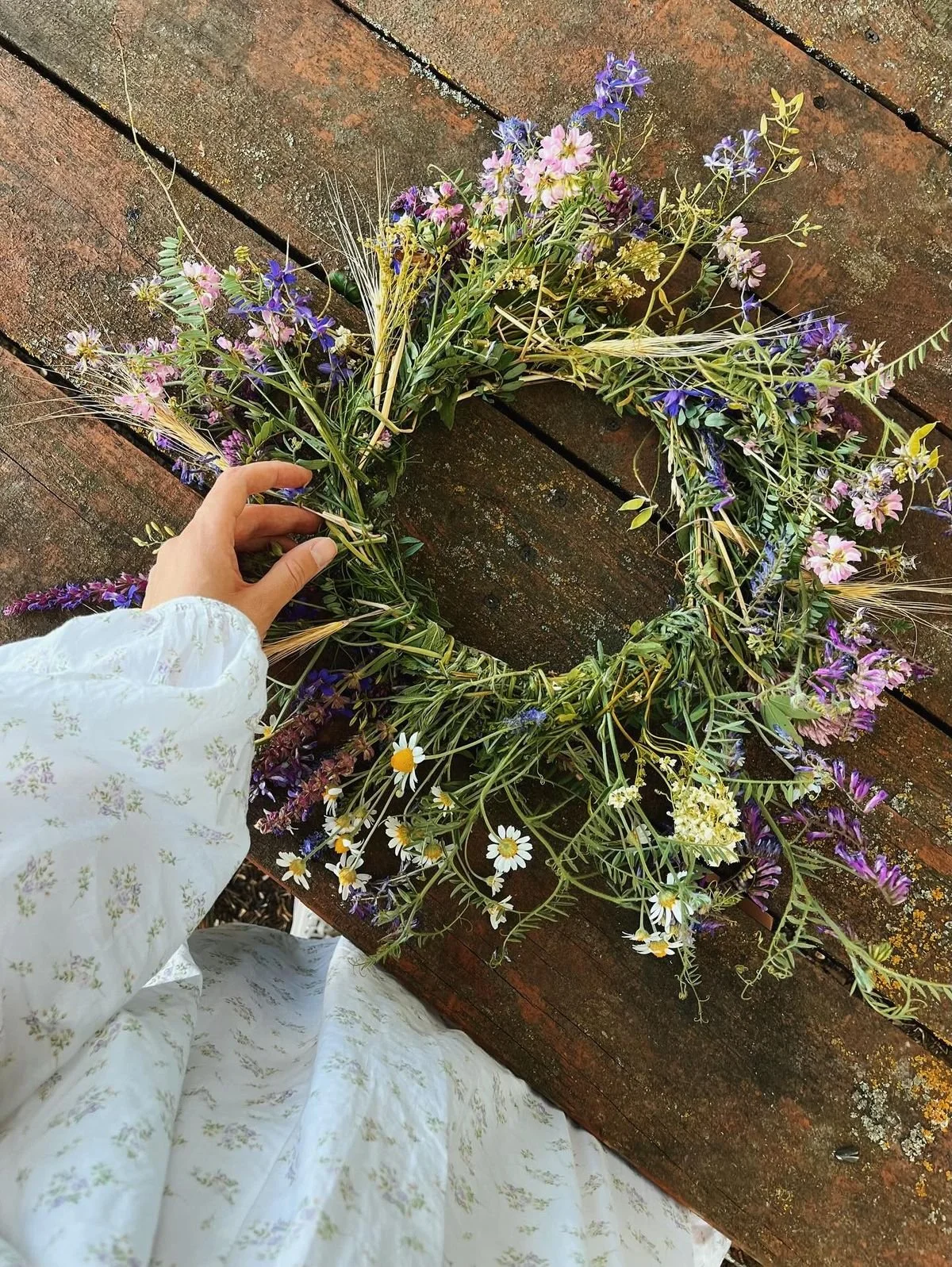
Make a flower crown or gather wildflowers. Midsummer and flowers are inseparable across nearly every cultural tradition that honors this time of year. Gather what's growing near you. Put wildflowers in a jar on your table. Tuck stems into your hair. It's one of those gestures that sounds small and feels quietly magical when you actually do it.
Sit with what's in full bloom in your life. Litha is the moment things are at their peak. Before you look ahead to what's next, take a moment to honestly acknowledge what has grown this year. What has bloomed that you planted earlier? What are you proud of? What feels full and good and worth savoring? This isn't a productivity review. It's a genuine pause to let yourself feel the abundance that's already present.
Watch the sunset. As the longest day draws to a close, step outside and watch the sun go down. Let it take as long as it takes. There's something about intentionally watching the sun set on the longest day of the year that is genuinely, quietly moving if you let it be.
Litha and the Wheel of the Year
If you're new to seasonal living, the summer solstice is one of the most intuitive entry points. The Wheel of the Year, the practice of marking the natural turning points of the seasons with intention and ceremony, is something many women are returning to as an antidote to a culture that never pauses long enough to feel anything.
You don't need to adopt any particular belief system to find meaning in it. At its simplest, seasonal living is just the practice of paying attention. Of noticing that summer feels different from winter. That there's a reason your energy shifts with the light. That your body, your creativity, and your emotional rhythms all move in patterns, just like everything else in the natural world.
Litha is one of the most accessible points on that wheel because it doesn't ask you to sit with anything difficult. It asks you to enjoy what's good. To be present for the fullness. To let summer in fully before it starts to turn.
A Note on Midsommar
If you've been drawn to the imagery of the Swedish Midsommar celebration and wondered how it relates to Litha, the answer is: they share the same root. Midsommar is the Scandinavian name for the midsummer festival, celebrated in Sweden, Norway, and Finland with maypoles, flower crowns, dancing, and outdoor feasting. The traditions have distinct origins but honor the same astronomical event and the same fundamental impulse: to gather together and celebrate the longest day with as much light, beauty, and joy as possible.
How Litha Fits Into a More Intentional Life
One of the things we love most about Litha is its particular emotional texture. It's joyful but not naive. It holds the fullness of summer and the quiet knowledge that the wheel keeps turning. It asks you to be present for the peak rather than rushing past it toward whatever comes next.
If you've been in a season of growth, doing the work, showing up, building toward something, Litha is the reminder to pause and look at what you've grown. The most intentional lives aren't just the ones that keep moving. They're the ones that stop, sometimes, to feel how far they've come.
Go outside. Feel the sun. Watch it set as slowly as you can stand to. Let the longest day be exactly as long as it is.
Happy Litha.
