
How to Celebrate the Summer Solstice This Year
Source: Eva Re | Dupe
You've felt it coming for weeks. The light lingering longer than you expected it to. The evenings still warm and bright at 8 p.m. The June afternoon that makes you want to stay outside for no reason except that it feels good to be there.
That feeling is building toward something. And on June 21st, 2026, it peaks.
The summer solstice is the longest day of the year, the moment the sun reaches its highest point in the sky and stays with us for more hours than any other day. It has been marked by humans across cultures and centuries, not because of anything mystical, but because something genuinely worth noticing is happening. The light is at its fullest. Summer is completely, undeniably here.
Here's how to celebrate it.
When Is the Summer Solstice in 2026?
In 2026, the summer solstice occurs on Sunday, June 21st, at 8:24 UTC, which translates to 1:24 AM Pacific Daylight Time and 4:24 AM Eastern Daylight Time in the Northern Hemisphere. It's the official astronomical start of summer, the longest day, and the shortest night of the year.
From June 22nd onward, the days very gradually begin to shorten again, which gives the solstice its emotional texture: it is both a celebration of fullness and a quiet acknowledgment that the wheel keeps turning. Which makes it worth marking thoughtfully.
A Brief History of Summer Solstice Celebrations
Humans have been gathering around the summer solstice for longer than recorded history. Stonehenge in England, dating back to around 2500 BC, was built in deliberate alignment with the solstice sunrise, suggesting that prehistoric people understood and honored this astronomical moment with real reverence. Every year, thousands of people still gather there on the solstice morning to watch the sun rise through the stones.
Across cultures, the summer solstice has been celebrated with fire, flowers, feasting, and community. In European pagan cultures, lighting solstice bonfires was believed to ensure a healthy harvest later in the year, while jumping over the fires could bring health, luck, and protection. In Sweden, customary midsummer celebrations involve dancing around a maypole, wearing flower crowns, and playing outdoor games. In ancient Greece, the summer solstice marked the first day of the calendar year and the countdown to the Olympic games.
In Christian tradition, the solstice was eventually linked to the feast of Saint John the Baptist on June 24th. However, pagan roots remain strong: the night between June 23rd and 24th is still considered magical in many traditions, and considered a perfect time for gathering medicinal herbs and preparing infusions left to soak overnight in the dew.
The details vary across cultures and centuries. But the impulse is always the same: to stop, gather, and acknowledge the light.
Why the Summer Solstice Resonates With So Many Women Right Now
We live in a culture that is very good at rushing. At moving from one thing to the next without pausing to feel where we are. The summer solstice is a direct counterpoint to that.
According to researchers, our circadian rhythms make us seasonal creatures, genuinely perceptive to changes in sunlight. "More and more, we are becoming disconnected from the rituals and structures of our past, living fast-paced lives that lead to social isolation," says one researcher. "Practicing rituals ties us back to the rhythms of the earth."
Marking the solstice doesn't require any particular belief system. It just requires a willingness to notice that something real is happening in the natural world and to let that be enough of a reason to pause. And for women who are drawn to a more intentional, seasonal way of living, the solstice is one of the most natural places to start.
How to Celebrate the Summer Solstice This Year
Wake up to watch the sunrise. The summer solstice sunrise is one of the most beautiful of the year, and it happens early. Waking up early to watch the solstice sunrise is one of the most popular modern traditions, with people gathering at local beaches, hillsides, and parks to be present for the longest day as it begins. You don't need to be anywhere special. Step outside with something warm to drink, face east, and let the light come to you.
Spend as much of the day outside as possible. The summer solstice is the year's greatest gift of daylight. Let yourself actually be in it. A long walk, a picnic in the sun, an afternoon reading in the garden, a barefoot hour in the grass. The invitation is simply to be present for the light rather than spending the longest day indoors.
Gather with people you love. The solstice has been a communal celebration across virtually every culture that has honored it. A dinner outside, a picnic in the park, a bonfire in someone's backyard, a late evening around a table with candles and good food and the windows open. Female friendships and community have been at the heart of seasonal gatherings for as long as people have gathered. Make this one of those evenings.
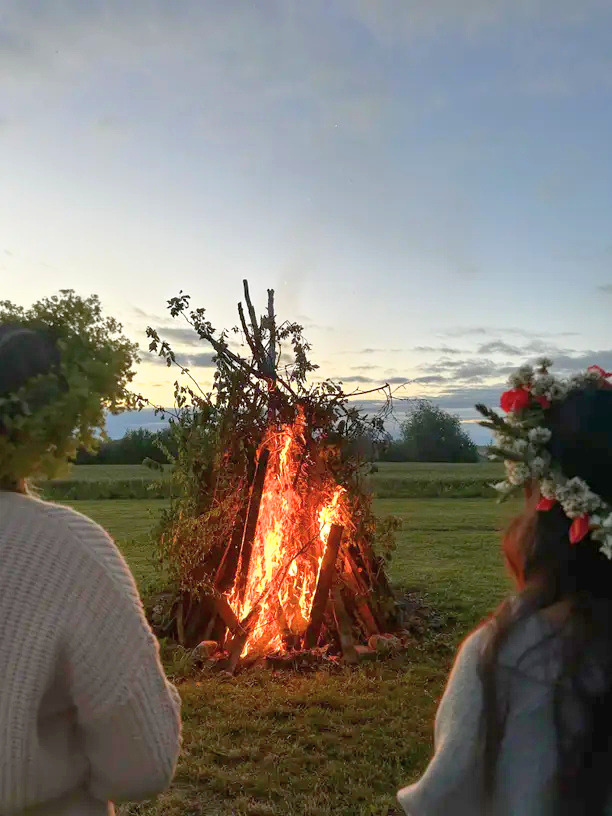
Light a fire, or a candle. Fire is the central symbol of the summer solstice across nearly every tradition that honors it. If you have access to a fire pit or a beach bonfire, this is the night for it. If not, candles carry the same spirit. Light them at sunset. Let them burn as the sky finally, gradually darkens. Stay with the light a little longer than usual.
Make flower crowns. This is one of the oldest and most cross-cultural midsummer traditions, and it's also genuinely joyful to do. Gather whatever is blooming near you, wildflowers, herbs, garden roses, whatever you can find, and weave them into crowns. Wear them. Tuck stems into your hair. It sounds fanciful until you're actually doing it, and then it feels exactly right.
Set an intention for the season. The summer solstice sits at the peak of the year, which makes it a natural moment to get quiet and honest about what you want this season to hold. Not a goal list. Just a feeling. What do you want more of? What are you ready to step into? What are you calling in? Write it down somewhere. Let the longest day be the day you name it.
Go for a midnight swim. If you have access to any body of water, the solstice is the night for a late swim. Ancient traditions practiced during this time of year include bonfires, fireworks, midnight swims, and fun gatherings. There is something about swimming in the dark on the shortest night of the year that is specifically, inexplicably magical. Try it at least once.
Watch the sunset. As the longest day finally draws to a close, go outside and watch it. Let the sky do what it does. Stay until the light is completely gone. There is something about intentionally watching the sun set on the solstice that is quietly moving in a way that's hard to explain and easy to feel.
Summer Solstice Celebrations Around the World
If you ever want to experience the solstice on a grander scale, a few celebrations are worth knowing about.
Stonehenge, England. Thousands of people gather every year at Stonehenge to watch the solstice sunrise through the ancient stones. It is one of the most extraordinary things you can witness, and entry to the stones themselves is free on the solstice.
Midsommar, Sweden. The Swedish Midsommar celebration, held on the Friday between June 19th and 25th, is one of the most beloved festivals in the world. Maypoles, flower crowns, dancing, outdoor feasting, and the particular magic of a Scandinavian summer evening where it never quite gets dark.
Santa Barbara, California. The city of Santa Barbara hosts a large annual solstice parade featuring colorful floats, music, and dancing, one of the most joyful community celebrations of the day in the United States.
Connecting the Solstice to How You Live
One of the most meaningful things about marking the summer solstice is what it does to your relationship with time. When you pay attention to the turning of the year, even in small ways, ordinary days start to feel like they belong to a larger rhythm. You notice the light differently. You feel the seasons differently. You become, just a little, more present in your own life.
The most intentional lives aren't necessarily the busiest or the most optimized. They're the ones that pay attention. That stop for the solstice. That build small ceremonies around the things worth celebrating.
If you want to go deeper on what the summer solstice means within the broader seasonal calendar, our guide to Litha covers the history and spiritual significance in more detail. And if you're looking for ways to make the whole summer feel more intentional and alive, our summer rituals for a softer life is a beautiful place to start.
The longest day of the year is coming. Go outside and feel it.
